
The Indian stock market is a classic example of what happens when speculation reaches its boiling point. After reaching an all-time high in May 2006, Bombay Stock Exchange's Sensex Index has fallen close to 30% in a month.
Neither the market nor the future can be predicted or controlled by the speculator, yet success is largely dependent upon them both.
To help make sense of the seemingly random behaviour of the stock market in the short-term, the speculator uses Technical Analysis. Technical Analysis gives a speculator the tools to "analyze" and "predict" the stock market - usually using trend lines, moving averages and other sophisticated statistical indicators.
Technical Analysis is popular with speculators because it is meant for people who want to make fast money. Unfortunately, like all things that are too good to be true, it does not work for the average person. But the lure of fast money (and a bull market!) is too strong for most to give up Technical Analysis.
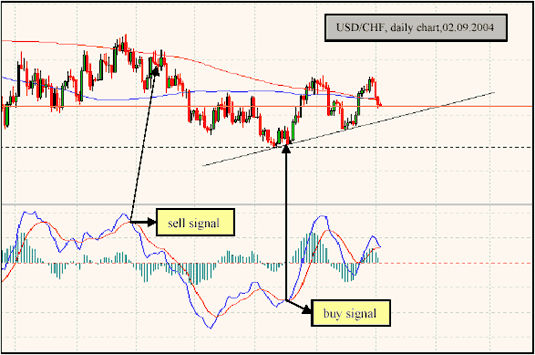 Since mathematics and statistics is used in Technical Analysis, it appears as if the actions of the speculator are legitimate - after all, mathematics can't be wrong! Besides, what is wrong with using Technical Analysis to help you decide when to buy, when to hold and when to sell?
People also talk about meaningless "support levels" for individual stocks and market indices, below which all hell can break loose. Support levels, trend lines etc. are akin to lines on our palm that supposedly tell our future! These are all very interesting things but not very useful if one wants to make money in the stock market over the long-term (10 years or more).
There are a few fundamental problems with Technical Analysis that need to be brought to people's attention:
1. The speculator has no margin of safety. Since a proper margin of safety is lacking, the risk taken is often too high.
In Technical Analysis, there is no such thing as buying "undervalued" or "underpriced" securities. Technical indicators generate 'buy' and 'sell' signals. In a significant number of cases, a 'buy' signal is not generated until after a significant rise in the stock price - thus, a speculator misses some truly "golden opportunities". The idea is that a speculator is willing to give up some upside in return for little or no downside.
Speculators are in the market to make fast money. Generally speaking, speculators do not buy shares based on the company fundamentals (like profitability, debt load, book value etc.) or valuation, they instead buy shares based on technical indicators.
This means that the price paid is irrelevant as long as the technicals are good. For this reason alone Technical Analysis is dangerous because one could end up buying when the market is overheated.
2. Technical Analysis is an art/skill, rather than a science.
It cannot be learned from a book. Either you have the skill and intuition to be a successful technical analyst, or you don't. Being "average" at this will not make you rich and may yield disastrous results.
In the long run, most speculators end up making little or no money at all, or worse yet, losing money! In most cases, their few large speculative profits are fully offset by the many small losses.
3. Technical Analysis favours stockbrokers.
Brokerage houses and stockbrokers encourage using technical analysis because it is good for their business. Speculators buying and selling using technical indicators will be doing so often simply because these indicators are generated as the share price rises and falls.
Frequent trades mean more commissions for brokers and lower profits for speculators. Technical Analysis discourages long-term perspective and forces speculators to buy and sell on a weekly and even daily basis.
As a matter of fact, in Canada, the broker charges a "maintenance fee" on an account in which there has been no trading activity in the past twelve months! It's obvious they do not want us to simply buy and hold stocks - which is an intelligent way of building wealth.
Technical Analysis is good if one desires to become a sheep in the stock market - i.e. buying when everyone is buying and selling when everyone is selling. It sure is a great way of obtaining mediocre returns!
So, what should an investor with a long time horizon use to buy stocks? Balance Sheet analysis (i.e. value investing) ofcourse! Read more here.